



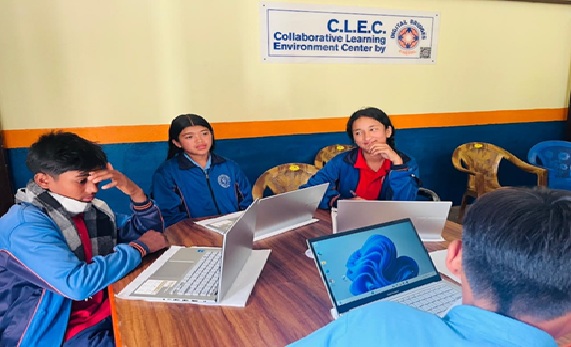
GORKHA: In an era where digital literacy dictates global opportunities, community schools in Nepal’s remote terrains have historically grappled with a starkly different reality. Limited technological resources, traditional rote-learning methodologies, and a lack of specialized teacher training have long restricted the academic horizons of rural students. However, a quiet educational revolution is unfolding in the historic foothills of the Bhimsen Thapa Rural Municipality in Gorkha.
A pioneering initiative—the Collaborative Learning Environment Center (CLEC) project implementing by Digital Bridges for Nepal (DB4N)—is successfully dismantling these barriers. The project has systematically reimagined the traditional public-school classroom into a dynamic, tech-driven, and student-centered hub.
The Anatomy of Transformation
The CLEC model moves far beyond the conventional computer lab. It integrates modern digital infrastructure, flexible physical workspaces, and a specialized pedagogical approach designed to foster peer-to-peer learning, critical thinking, and collective problem-solving among students. Focused primarily on students from Grades 9 to 12, the project was rolled out across four distinct community schools: Shree Brindawati Secondary School (Masel), Shree Siddhakali Secondary School (Tandrang), Shree Shanti Secondary School (Baguwa), and Shree Saraswoti Secondary School (Borlang) since April 2025.
According to a comprehensive eight-month impact assessment report conducted in December 2025, the project has directly and indirectly benefited 920 students and nearly 100 educators in the municipality. Strikingly, of the 341 students directly utilizing the CLEC facilities daily, over 56% are girls, marking a significant stride toward bridging the gender gap in STEM and digital education in rural Nepal.

Data and Voices of Impact
The quantitative and qualitative outcomes of the impact assessment paint an overwhelmingly positive picture of classroom engagement and academic motivation:
Enhanced Motivation: An astronomical 95% of surveyed students reported an increased interest in their studies since the introduction of the CLEC room.
Better Comprehension: 78% of students noted that complex subject matter became substantially easier to understand through interactive digital tools.
Soft Skills Development: 85.7% of participants expressed that collaborative learning drastically improved their communication, teamwork, and social skills.
“When we do research about our courses in the CLEC class, we learn much more than what the teachers have taught us because we have internet access,” says Sudip Lamichhane, a local high school student. “If we want to know about something, we simply move to the CLEC class and research it ourselves.”
Educators have experienced an equally profound shift, moving away from teacher-centric lectures to becoming facilitators of active learning. Jit Bahadur Ale, a participating teacher, notes: “CLEC is the bridge of learning using technology. It encourages students to solve problems through self-study and promotes learning by doing. It helps them learn practically rather than theoretically.”
From Classrooms to Community Hubs
What makes the CLEC intervention uniquely sustainable is its vision to empower the broader rural ecosystem. Local government officials view these centers as critical civic infrastructure rather than isolated school projects. The initiative aims to establish digital connectivity across all eight wards of the municipality, linking schools, local health posts, and governance offices.
Lok Prasad Banjara, Chairman of Bhimsen Thapa Rural Municipality, observed a visible behavioral shift in students, noting that the centers have deeply motivated independent research. Looking forward, Narayan Prasad Shrestha, a Ward and School Management Committee Chairman, outlines an expanded blueprint: “We are planning to upgrade the skills and knowledge of our local women’s groups, youth clubs, and farmers’ groups with the help of CLEC.”
Navigating Challenges for the Future
While the initial eight months have proven immensely successful, the impact report highlights crucial areas that require sustained local investment and structural maintenance. As student enthusiasm continues to surge, schools face operational bottlenecks including limited furniture, an insufficient laptop-to-student ratio, inconsistent internet bandwidth, and the need for ongoing technical maintenance. Furthermore, there is a recurring demand from school faculties for continuous, need-based professional capacity-building training for both CLEC and non-CLEC teachers.
As public education in Nepal faces mounting pressure to modernize, the collaborative model engineered by DB4N in partnership with KUSOED in Gorkha provides a scalable, battle-tested blueprint. By blending grassroots infrastructure with academic oversight, the CLEC project demonstrates that with the right partnership, rural community schools can leapfrog technological divides and cultivate the next generation of digitally empowered leaders.